Living in High Desert Albuquerque in 2026: Gated Streets, Passive Solar Architecture, and What Buyers Trade Off for Views Above the City
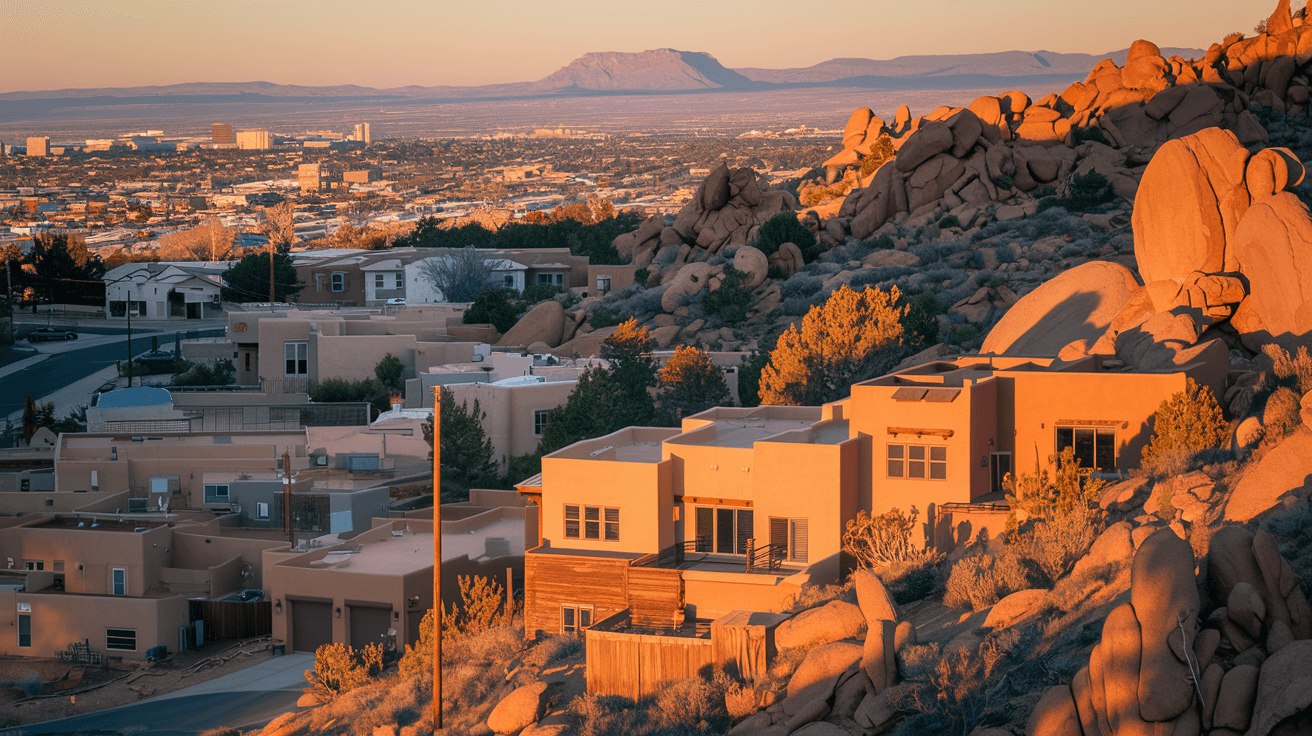
There's a moment, usually around dusk, when you're standing on a High Desert back patio and the Sandias go full watermelon pink behind you while the city grid below starts flickering to life like a dropped handful of diamonds. It's the kind of thing that makes people sign contracts they hadn't planned on signing that week. Living in High Desert Albuquerque is genuinely different from living anywhere else in the metro, and in 2026, with the broader Albuquerque market sitting at a metro median of $385,000 and inventory hovering around 3.9 months, this neighborhood operates in its own gravitational field — a median closer to $775,000, a buyer pool that researches for months before they tour, and a lifestyle that rewards people who know exactly what they want.
This isn't a neighborhood you stumble into. You climb into it, literally, winding up past the foothills on roads like High Desert Place or Tramway Boulevard until the city drops away behind you and the desert takes over. If you've been thinking about making that move, or you're just trying to understand what the premium actually buys you, this is the honest conversation.
High Desert Albuquerque Neighborhood Guide: The Lay of the Land
High Desert sits on Albuquerque's northeastern bench, tucked against the Sandia Mountain foothills and bordered by Tramway Boulevard to the east and the Paseo del Norte corridor to the north. The neighborhood was master-planned with a specific philosophy: preserve the volcanic rock outcroppings, build around the arroyos rather than through them, and keep the density low enough that every home feels like it's on its own piece of the mesa.
The result is a community of roughly 1,000 homes spread across terrain that most developers would have found too complicated to bother with. Boulders the size of small cars sit in front yards as landscape features. Walking trails connect cul-de-sacs through open space that the HOA maintains as permanent preserve. The Embudito Canyon trailhead is essentially in the neighborhood's backyard, which means residents have direct access to some of the best hiking in the Cibola National Forest without driving anywhere.
The gated entry points are one of the first things buyers ask about. High Desert uses a staffed gate on High Desert Place as its primary controlled access, with secondary access points that use resident transponders. This isn't theater security — the gate staff know the regulars, keep visitor logs, and are genuinely attentive. For buyers coming from other parts of Albuquerque or relocating from larger metros, the gate feels like a meaningful layer of privacy rather than just a marketing feature.
“"High Desert doesn't feel like a subdivision. It feels like someone figured out how to build a neighborhood inside a nature preserve and then decided to add the city view as a bonus."
Passive Solar Architecture and Home Design in High Desert ABQ
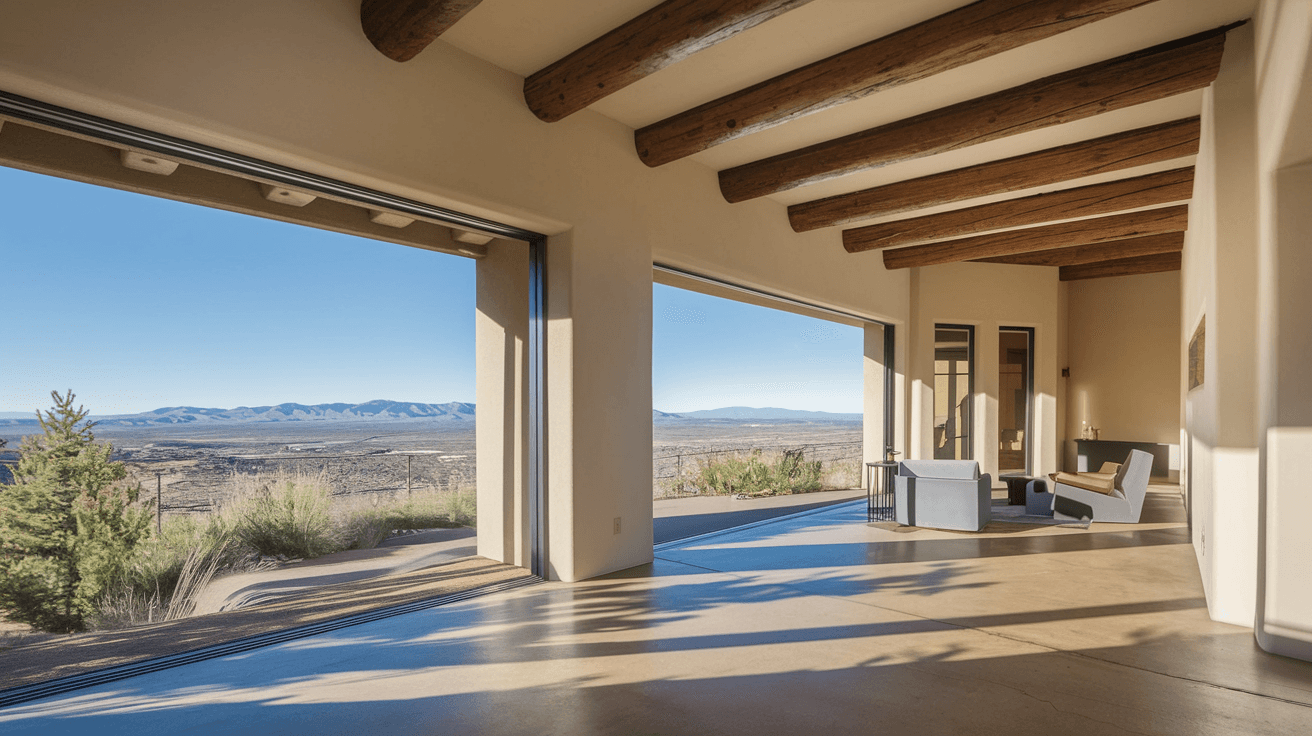
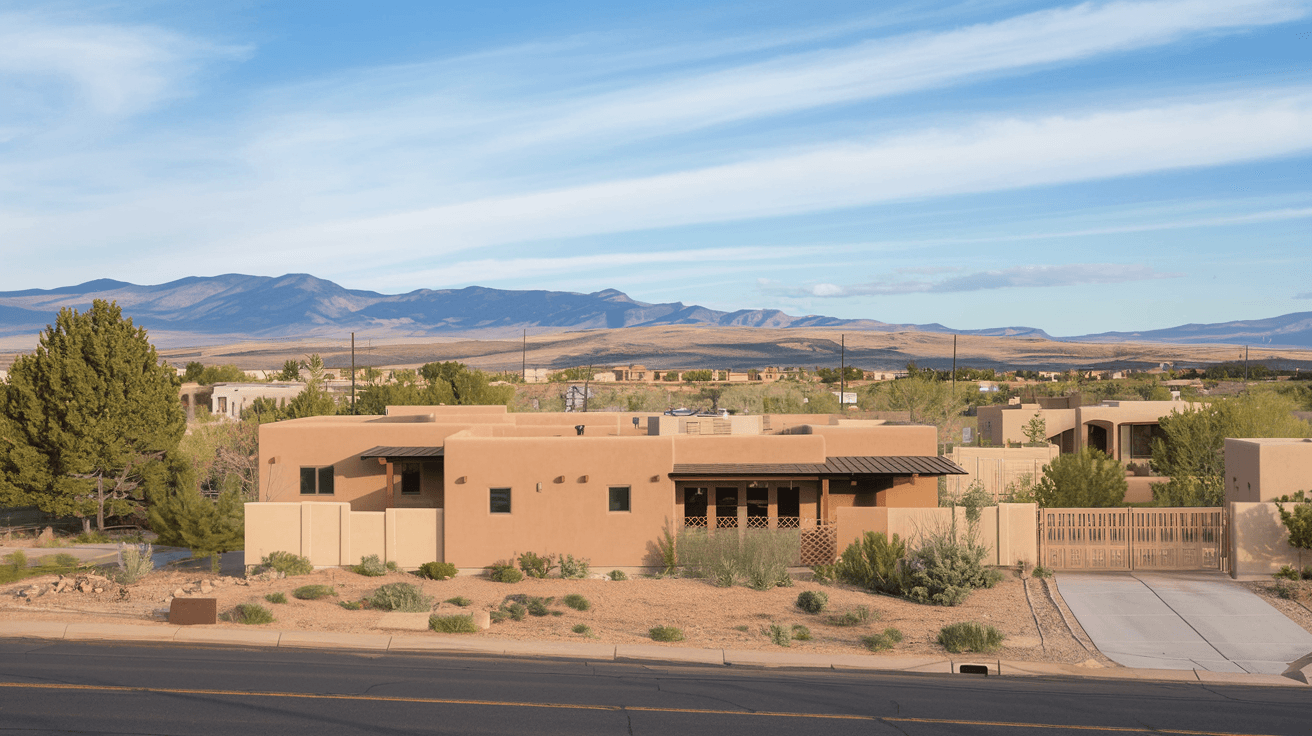
One of the things that separates High Desert ABQ homes from the broader Albuquerque luxury market is the architectural consistency. The neighborhood CC&Rs require designs that respond to the high desert environment, which in practical terms means you'll see a lot of passive solar design, thick adobe or rammed earth walls, south-facing glazing, and overhangs calculated to block the high summer sun while letting the low winter sun heat interior slabs.
This isn't just aesthetic preference. At 6,000 feet elevation with 300-plus days of sunshine, a well-designed passive solar home in High Desert can dramatically reduce heating and cooling loads. Buyers who've lived in conventional Albuquerque construction are sometimes surprised by how different the indoor environment feels — cooler in summer without the air conditioning running constantly, warmer in winter from thermal mass that releases heat through the night.
The architecture vocabulary across the neighborhood includes:
- •Contemporary pueblo revival homes with flat roofs, vigas, and smooth stucco in earth tones
- •Territorial style houses with brick coping on parapets and more formal symmetry
- •Desert modern designs that came in during the 2010s and 2020s, featuring floor-to-ceiling glass on the city-view side and minimalist material palettes
- •Custom homes on larger lots that blend multiple traditions but almost universally prioritize view corridors toward the Rio Grande valley
The lot sizes trend larger than most Albuquerque neighborhoods, with many parcels running a third to a full acre. That space matters when the homes themselves often run 3,000 to 5,000 square feet. You're not buying density here. You're buying separation.
One thing worth knowing if you're touring homes: the city views are not uniform across the neighborhood. Homes on the western-facing ridgelines have the classic unobstructed panorama from the Petroglyphs all the way to Mount Taylor on a clear day. Homes tucked into the canyon draws or on the eastern side of internal streets may have stunning mountain views but limited city lights. Ask your agent to be specific about view orientation before you fall in love with a floor plan.
High Desert ABQ Homes for Sale in 2026: What the Market Actually Looks Like
The High Desert ABQ homes for sale 2026 picture is one of selective activity. While the broader Albuquerque metro is seeing around 31 days on market and a list-to-sale ratio of 98.1 percent, High Desert operates on a longer decision cycle. Buyers at the $700,000 to $1.2 million price point are deliberate. They're often comparing High Desert against Tanoan, Sandia Heights, or even properties in Santa Fe, and they take their time.
That said, well-priced, well-presented homes in High Desert don't sit. The neighborhood's median home price around $775,000 reflects the combination of lot premiums, architectural quality, and the view factor, but there's real variance. A 3,200-square-foot home on an interior street without a city view might list in the mid-$600,000s. A 4,500-square-foot contemporary with a protected western view corridor and recent kitchen renovation can push past $1.1 million without much resistance.
“"The buyers who do best in High Desert are the ones who've done their homework on the specific block, the specific view, and the specific HOA implications before they ever schedule a showing."
With metro-wide active listings around 3,850 and months of inventory at 3.9, Albuquerque as a whole is still a seller-favorable market, but High Desert's limited lot count creates its own supply constraint. New construction is essentially finished here — the developable land is gone. Every transaction is a resale, which means the neighborhood's character stays consistent but also means you're competing for a finite pool of homes.
If you're serious about living in High Desert Albuquerque and want to understand what's actually available right now versus what might come to market in the next 90 days, reach out to the Taylor Team. We track this neighborhood closely and often know about homes before they hit the MLS.
Living in High Desert Albuquerque: The Real Tradeoffs
Here's where the honest conversation happens. High Desert is genuinely wonderful, and it's also genuinely inconvenient in specific ways that matter to some buyers more than others.
The commute question is real. If you work downtown near the Alvarado Transportation Center, in the Journal Center corridor, or at Presbyterian Hospital on Coal Avenue, you're looking at a 20 to 35-minute drive depending on time of day. Tramway is efficient but not infinite, and the connection to I-25 at Paseo del Norte has its morning rhythm. Buyers who work in the Northeast Heights near Uptown or in the Cottonwood area have a better story, but nobody in High Desert is walking to a coffee shop on a Tuesday morning.
The closest daily conveniences are down the hill. The Sprouts on Montgomery is a 10-minute drive. The Trader Joe's on Carlisle requires committing to Paseo del Norte. For a quick dinner out, most High Desert residents end up on Paseo del Norte heading toward the Flying Star on Paseo or dropping into the Nob Hill area on Central. The neighborhood itself has no commercial corridor.
The HOA is substantive. Monthly dues fund the gate staffing, trail maintenance, common area landscaping, and architectural review. The architectural review committee has real authority over exterior changes, paint colors, additions, and landscaping. Buyers who want to paint their house a color that doesn't appear in the approved palette will have a conversation with that committee. For most High Desert buyers, this is a feature, not a friction point — it's what keeps the neighborhood looking the way it does. But if you're someone who wants to build a detached workshop or park an RV on your driveway, this is not your neighborhood.
Wildfire awareness is part of life here. The neighborhood's position against the Sandia foothills means residents think about defensible space, ember-resistant vents, and fire-wise landscaping in a way that someone living near the river doesn't have to. The City of Albuquerque's Open Space division does prescribed burns in the foothills, and there are years when smoke sits in the canyon draws for days. The neighborhood has evacuation plans and most longtime residents know them. This isn't meant to alarm anyone — High Desert has an excellent safety record and the defensible space requirements actually result in beautiful, low-water native landscaping. But it's a real part of the lifestyle calculus.
Schools and the La Cueva High School District
High Desert sits in the APS La Cueva High School attendance zone, which is consistently one of the most sought-after assignments in Albuquerque Unified. La Cueva's academic programs, athletics, and extracurriculars draw families from across the northeast quadrant, and being in-boundary rather than seeking a transfer matters for enrollment. Elementary students typically feed through Tres Colinas Elementary and then Eisenhower Middle School before La Cueva. For families with school-age children, this pipeline is often a significant driver of the decision to buy in High Desert specifically rather than the broader foothills area.
The Insider Detail Most Buyers Don't Know
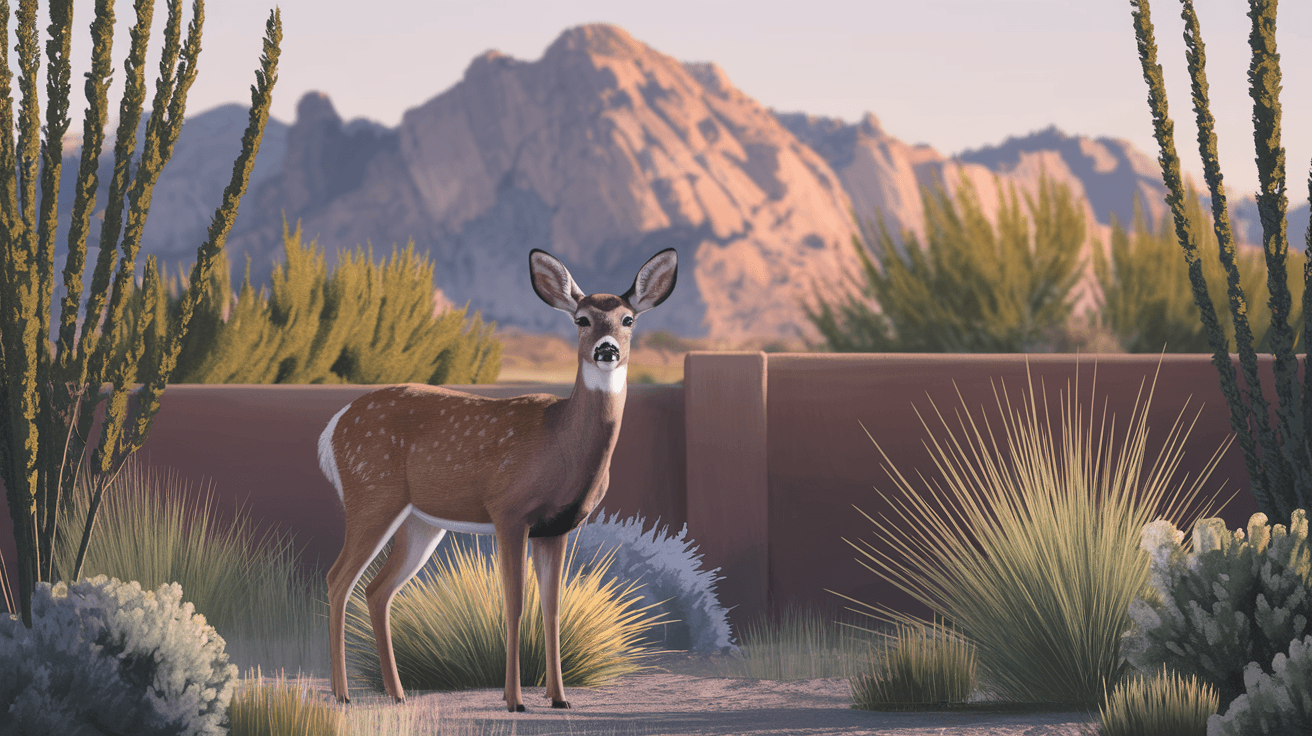
Here's something that only comes up if you've spent real time in the neighborhood: the wildlife corridor along the eastern edge of High Desert is active in ways that surprise new residents. Mule deer move through the arroyos regularly, particularly at dawn and dusk. Black bears occasionally come down from the Sandias in late summer when the acorns are ripe. Coyotes are a constant presence. This isn't a warning, it's context. Residents who've lived here five years treat a deer in the backyard like a neighbor waving from across the street. But new buyers with small dogs or outdoor cats need to know that the high desert wildlife situation is not abstract here — it is literally in your yard.
Is High Desert the Right Neighborhood for You in 2026
The buyers who thrive in High Desert Albuquerque tend to share a few things. They value quiet and privacy over walkability and urban convenience. They find meaning in the natural landscape and want their home to be in genuine conversation with it. They're comfortable with a premium price point and understand that the HOA structure is what protects that investment. And they usually have a specific life setup — remote work, a short commute, or a household where one partner works from home — that makes the location work logistically.
The buyers who tour High Desert and end up somewhere else usually want more neighborhood energy, shorter drives to their daily routine, or a price point that lets them spend more on the interior of the home rather than the land and the view. Those are completely legitimate priorities, and there are great neighborhoods in Albuquerque that serve them well.
But if you've been dreaming about watching the Sandia Mountains turn pink from your own back patio, about hiking out your front gate into the foothills before the city wakes up, about a home that was designed to work with the New Mexico sun rather than fight it — High Desert is the real version of that dream. Not a marketing brochure version. The actual thing.
The Taylor Team has helped buyers and sellers navigate High Desert and the broader Albuquerque foothills market for years. If you want a straight conversation about what's available, what's coming, and whether this neighborhood fits your life in 2026, we're easy to reach and we don't do pressure.
Want more insider intel?
Subscribe to get market updates and new articles delivered to your inbox.