
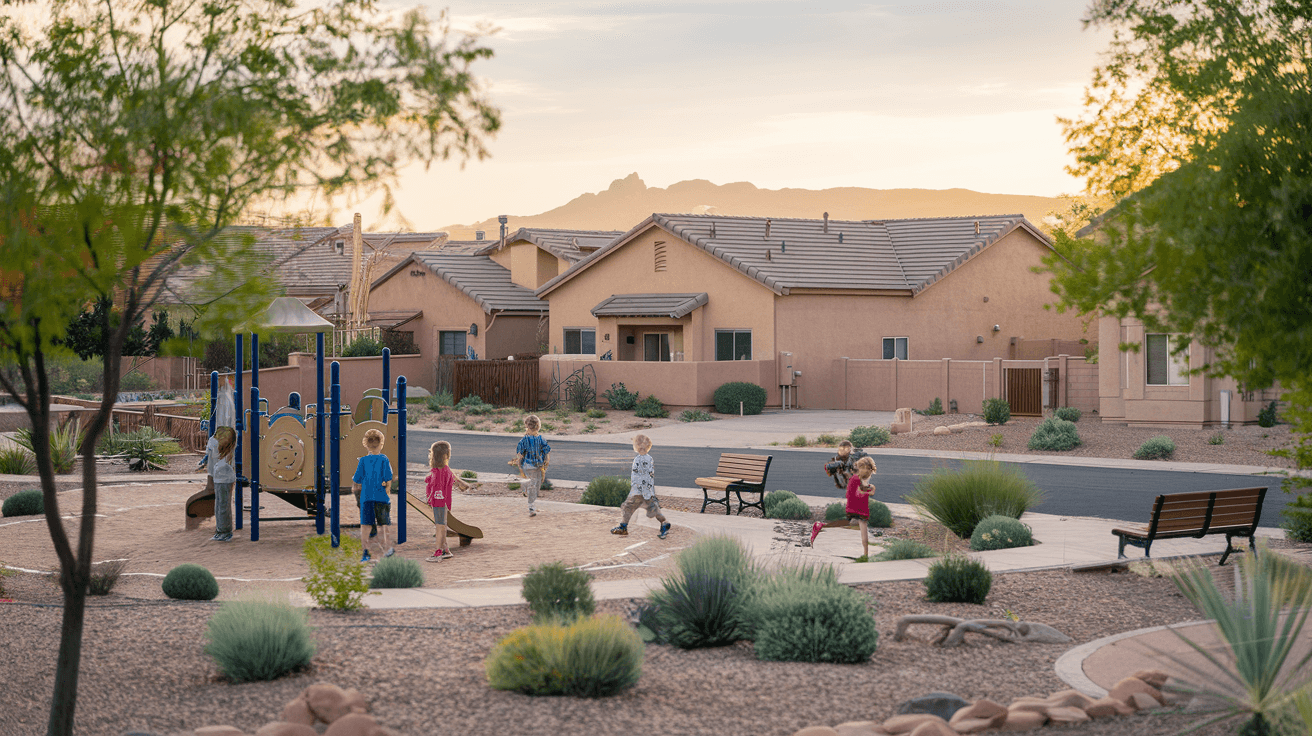
Best Neighborhoods in Albuquerque for Families in 2026
What Makes a Neighborhood Great for Families in Albuquerque?
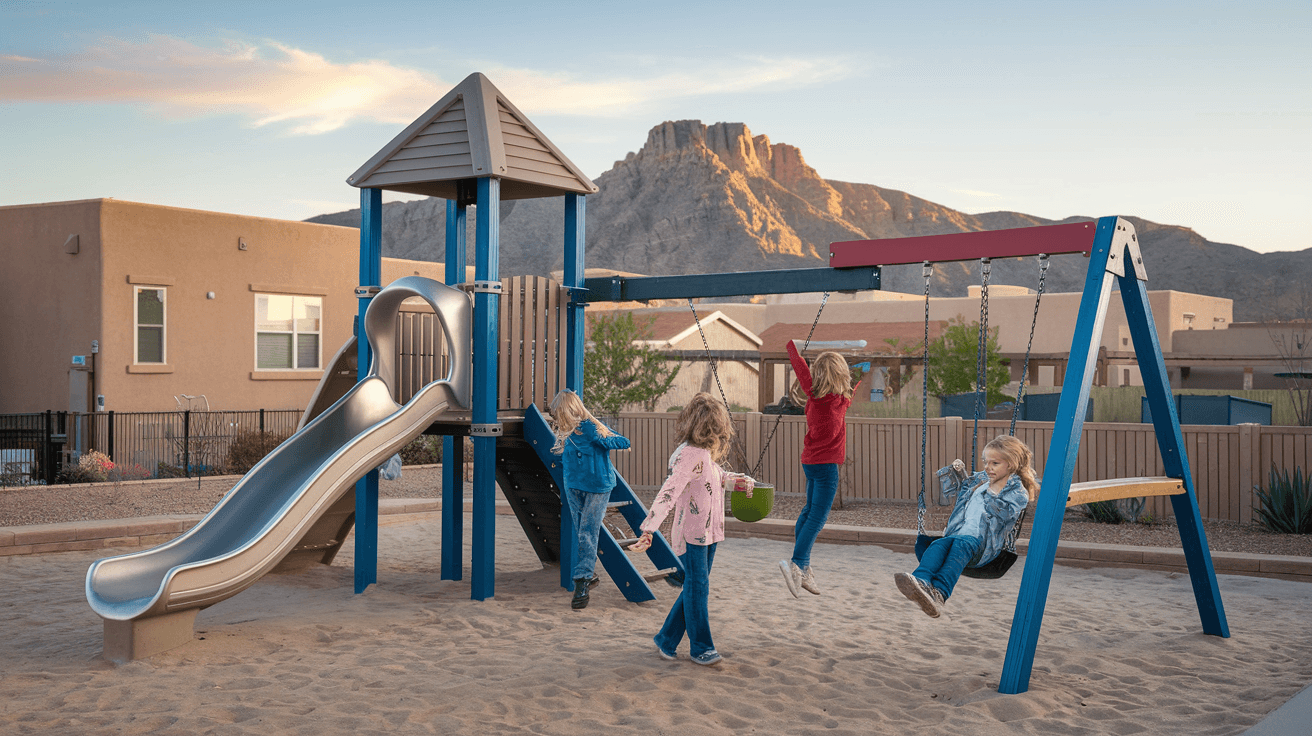
This question comes up in almost every buyer consultation I have with a family relocating to Albuquerque — from a military PCS out of Kirtland, from a tech transfer in from California, from a UNM medical resident who just matched and needs to figure out where to live with a toddler and a dog. The answer is never just school ratings. It is the combination of school quality, park access, neighborhood walkability, perceived safety, commute reality, and the simple question of whether the block feels like a place where kids can grow up.
Albuquerque is not one uniform city. It is a collection of distinct communities, each with its own character, demographics, and trade-offs. The five areas I am going to walk you through — the Northeast Heights La Cueva zone, Taylor Ranch, Ventana Ranch, High Desert, and Rio Rancho — represent the strongest options for families in 2026, with honest commentary on the numbers, the commutes, and the things the school ratings websites do not tell you.
Northeast Heights: The La Cueva Zone
If school quality is your primary filter, the Northeast Heights neighborhoods that feed into La Cueva High School are the most consistently sought-after family real estate in Albuquerque. This is not a secret — buyers from out of state research it before they even land at Sunport, and the demand is reflected in the prices.
La Cueva High School routinely ranks as one of the top public high schools in New Mexico, with strong AP program participation, competitive athletics, and a college placement rate that reflects a school community that takes academics seriously. The feeder schools — Chaparral Elementary, James Monroe Middle School, and the cluster of elementaries along Academy Boulevard — are well-regarded within Albuquerque Public Schools and attract actively involved parent communities.
The neighborhoods themselves — the streets around Tramway and Academy, the established subdivisions off Glenwood Hills Drive, and the corridors running toward the Juan Tabo foothills — are the kind of suburban Albuquerque that people picture when they think of a stable, family-oriented block. These are mostly homes built in the 1970s through 1990s, single-story or split-level, with mature landscaping, setback garages, and the kind of street trees that take 30 years to grow.
Price range: $360,000 to $520,000 for a three- to four-bedroom family home in the La Cueva zone. The lower end of that range puts you in older construction with original kitchens and bathrooms. The upper end gets you into homes that have been renovated or were built later in the 1990s with larger floor plans.
Commute reality: Sandia National Laboratories is roughly 10 to 15 minutes east via Eubank and Kirtland-adjacent employers are 20 to 25 minutes south. Downtown Albuquerque is 25 to 30 minutes depending on traffic on I-25. Presbyterian Hospital's main campus on Coal is 25 minutes without traffic. The commute calculus works best if at least one partner works on the northeast side of the metro.
Parks and outdoor access: This is where the La Cueva zone genuinely separates itself. Elena Gallegos Open Space at the base of the Sandias is minutes away — 640 acres of trails, rock scrambles, and pinon-juniper woodland that you can access on a Tuesday evening after dinner. The Embudo Trail picks up near Girard and offers a direct hiking corridor into the Sandia foothills. For families who care about outdoor lifestyle alongside school quality, this combination is hard to beat anywhere in the metro.
“The thing I tell families coming from Denver or the Bay Area: in most cities, you are choosing between great schools and outdoor access. In the La Cueva zone, you get both within five minutes of your house. That is genuinely unusual.
Taylor Ranch
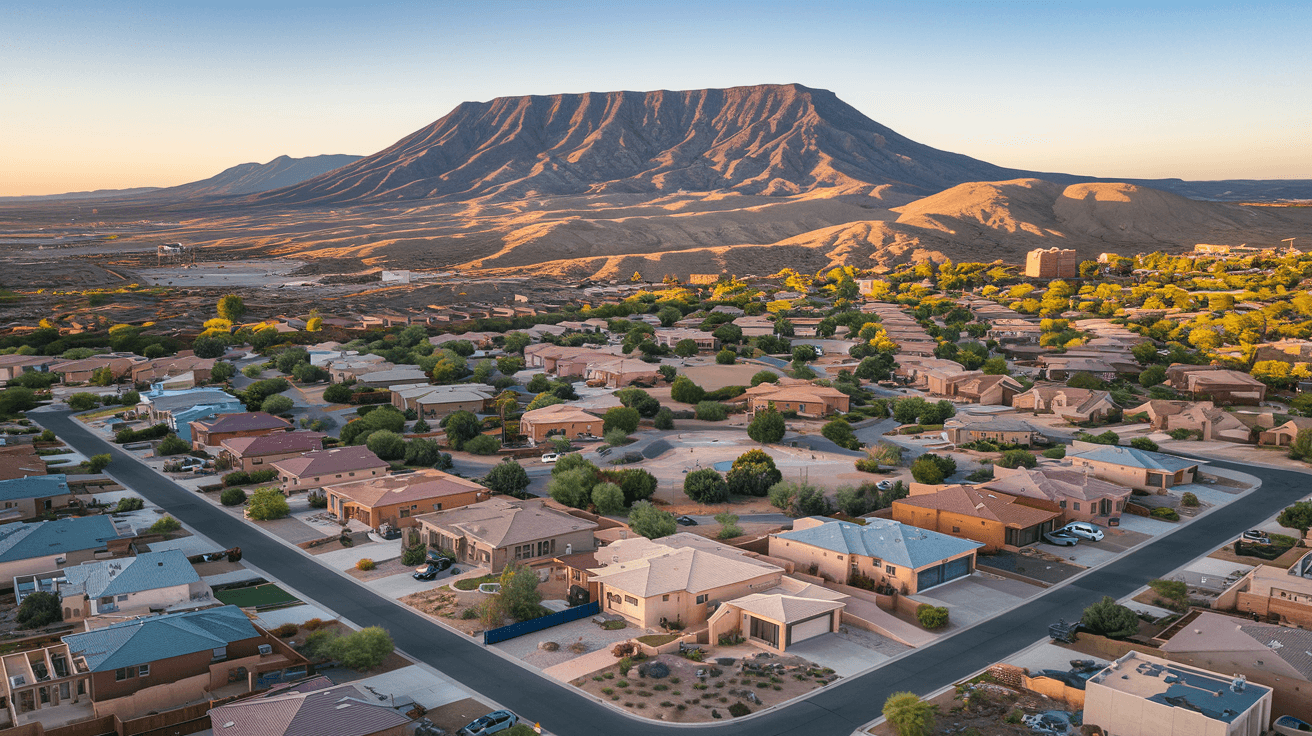
Taylor Ranch is the West Side neighborhood that consistently surprises people who have written off the West Side as sprawl without character. It is a large, established community roughly bounded by Coors Boulevard on the east, Montano on the south, Paseo del Norte on the north, and the mesa edge approaching the Petroglyph National Monument on the west. Families have been choosing it for 25 years for one core reason: you get more house for your money than the Northeast Heights, the schools are genuinely good, and the commute to the northwest employers is the best in the metro.
Schools: Taylor Ranch feeds into Cibola High School, which has a solid academic reputation within APS and serves a stable, family-oriented demographic. The elementary schools in the Taylor Ranch cluster — including Taylor Ranch Elementary and neighboring schools — have consistent parent engagement and PTA cultures that drive real outcomes.
Price range: $290,000 to $420,000 for family-sized homes. The value comparison to the Northeast Heights is stark. A home in Taylor Ranch that would cost $440,000 in the La Cueva zone might be $330,000 here. For families maximizing space — needing four bedrooms, a yard big enough for a swing set, and a two-car garage — Taylor Ranch pencils out in a way the northeast side sometimes does not.
Commute reality: If you work at Intel's Rio Rancho campus, Taylor Ranch might be the single best neighborhood in the metro. The Paseo del Norte to Unser run is 15 to 20 minutes with minimal traffic stress. Kirtland AFB is 25 to 30 minutes south on Coors to I-40. Downtown Albuquerque is 20 to 25 minutes. The one commute that is genuinely inconvenient from Taylor Ranch is anything in the Southeast Heights or the Kirtland AFB flight line side — that is a cross-metro drive that adds up over time.
Parks and outdoor access: Petroglyph National Monument is practically in the backyard. Thousands of ancient carved images on basalt boulders, multiple trail systems, and free access on most days. Cottonwood Mall is nearby for the practical errands, and the Bosque trail system accessible from Montano offers biking and walking along the river. Taylor Ranch is not a glamorous neighborhood in the way Nob Hill is glamorous, but it functions exceptionally well for a family with kids in school and both parents working.
Ventana Ranch
Ventana Ranch is the West Side's newer, more planned cousin to Taylor Ranch. Developed mostly in the 2000s and 2010s, it sits north of Paseo del Norte and west of Eagle Ranch Road, and it has the infrastructure that comes with newer construction: sidewalks on every street, community parks integrated into the subdivision design, and homes that were built with open floor plans and attached two-car garages.
Schools: Ventana Ranch feeds into Volcano Vista High School, which opened in 2009 and has quickly built a reputation for strong athletics and a community-oriented culture. The feeder elementary schools in the Ventana Ranch development were designed into the neighborhood plan — Ventana Ranch Elementary is actually inside the community, which means kids can walk or bike without crossing major roads.
Price range: $320,000 to $480,000. The newer construction commands a modest premium over Taylor Ranch, but the homes tend to have more square footage, more modern finishes, and fewer deferred maintenance concerns. A 2,200-square-foot four-bedroom home with a three-car garage in Ventana Ranch might be $385,000 — that same home in the Northeast Heights equivalent would be $450,000 or more.
Commute reality: Similar to Taylor Ranch — excellent access to Intel and Rio Rancho employers, reasonable access to Kirtland AFB and the Sandia Labs. The Intel and Hewlett Packard campuses in Rio Rancho are genuinely close, which makes Ventana Ranch one of the best neighborhoods in the metro for tech sector employees.
Family feel: Ventana Ranch has the most consistently suburban, family-focused character of any neighborhood on this list. The streets are wide, the parks are well-maintained, and weekend mornings are full of youth soccer and kids on bikes. If you are coming from a suburban background in Texas or Arizona and want Albuquerque without the urban grit of the older city neighborhoods, Ventana Ranch reads as familiar and comfortable immediately.
High Desert
High Desert is Albuquerque's prestige family neighborhood — the place where physicians, senior Sandia Labs engineers, successful business owners, and longtime Albuquerque families who have done well choose to raise children. It is a gated community in the Tramway foothills northeast of the city, and it is not for every family's budget, but for those it fits, there is nothing else quite like it.
Schools: High Desert feeds into La Cueva High School and the same northeast feeder cluster. But the property itself adds something beyond school ratings: the sheer physical environment. Kids growing up in High Desert have open space trails, wildlife (roadrunners, coyotes, the occasional black bear in fall), and views of the entire Albuquerque metro from their backyard. That environment shapes a childhood in ways that are hard to quantify.
Price range: This is a luxury neighborhood. Entry-level homes in High Desert start around $900,000 to $1.1 million, and the median sale price is approximately $1.2 to $1.3 million. Larger custom homes and properties with exceptional views or recent renovations push toward $2 million and beyond. This is not a neighborhood where you are stretching a $400,000 budget — it is where you land after years of equity accumulation or a significant income event.
Commute reality: Sandia National Laboratories on Eubank is 20 to 25 minutes. Kirtland AFB is 25 to 30 minutes. Downtown is 30 to 35 minutes. The trade-off of the foothills location is real — High Desert is not convenient to anything below Tramway, and residents accept that daily commutes will be a few minutes longer than from the flatter northeast neighborhoods.
Why families choose it: Privacy, safety, space, and the Sandia Mountains as a literal backyard. The trails accessible directly from High Desert roads connect to the Sandia Mountain Wilderness within minutes on foot. For families who ski, Sandia Peak Ski Area at the top of the Tramway is 15 minutes. There is a reason that once people buy in High Desert, they rarely leave.
Rio Rancho
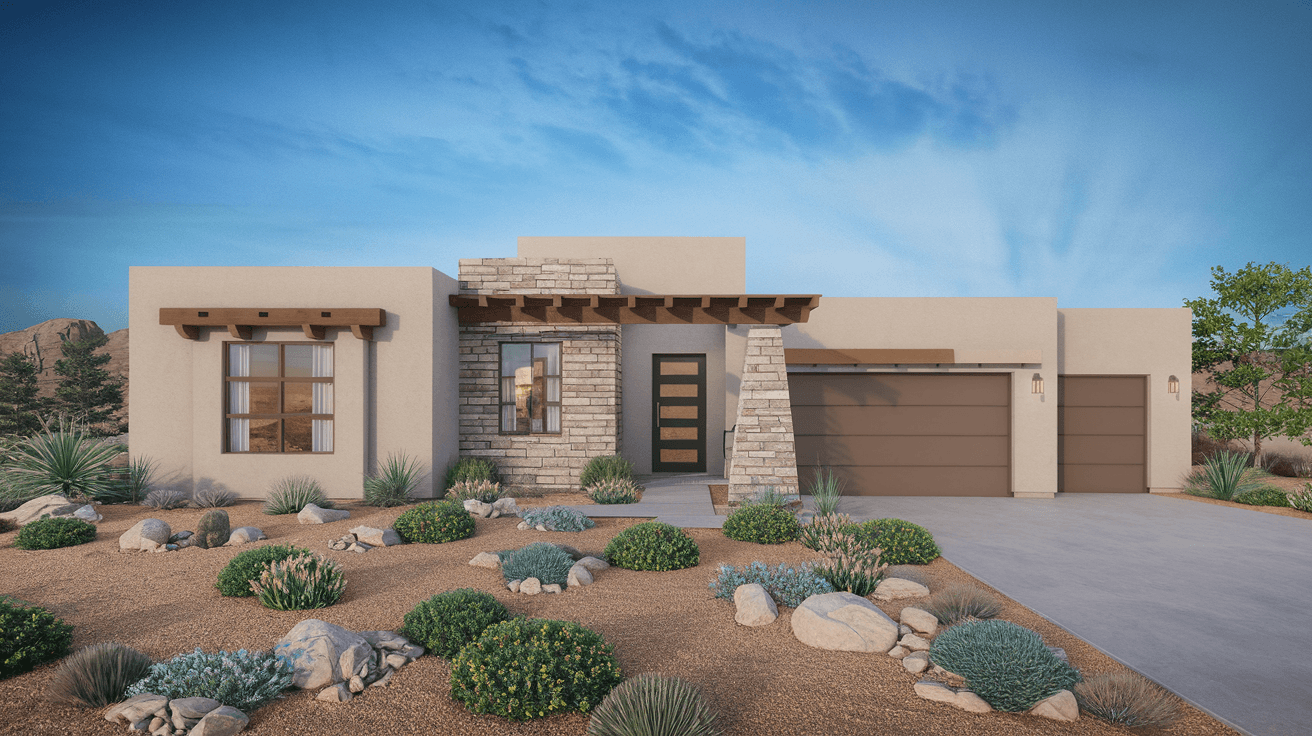
Rio Rancho is not technically Albuquerque — it is its own city of roughly 100,000 people in Sandoval County — but it functions as part of the metro and belongs on any honest list of the best places for families in the region in 2026. The Intel effect has transformed it from a bedroom community into a genuine employment hub, and that has cascading effects on everything from restaurant quality to school funding.
Schools: Rio Rancho is served by the Rio Rancho Public Schools district, which is separate from APS and has developed a reputation for strong academics in the past decade. Cleveland High School and Rio Rancho High School are both well-regarded, and the district has benefited from the population growth and tax base that comes with a major employer like Intel anchoring the local economy.
Price range: $280,000 to $420,000 for family homes. Rio Rancho offers some of the best square-footage-per-dollar in the metro, particularly in neighborhoods like Cabezon (with its community pool and parks system), the streets around Southern Boulevard, and the newer developments on the western mesa near Unser and Lomas.
Commute reality: If your job is in Rio Rancho or at Intel, the commute is exceptional. If your job is at Kirtland AFB, plan for 40 to 50 minutes via I-25 — it is manageable, but it adds up. Sandia Labs on Eubank is a 35-minute drive on a good day.
Family infrastructure: Rio Rancho has invested heavily in parks, trails, and recreation facilities as the population has grown. Cabezon Community Center has a full aquatics program. The Paseo del Volcan trail system offers mountain biking and hiking without driving into Albuquerque. And the sheer density of new construction means that most of the housing stock is modern, energy-efficient, and move-in ready without the renovation projects that come with Albuquerque's older neighborhoods.
“What I tell families comparing Rio Rancho to the West Side of Albuquerque: the biggest difference is that Rio Rancho is its own city with its own school district, its own city services, and its own property tax structure. For families who work in Rio Rancho, it is the obvious choice. For everyone else, the commute calculus matters.
Making the Decision
The honest truth is that the best neighborhood for your family depends on three things: where you work, what your school priorities are, and what your budget allows. None of these five areas is the objectively correct answer — each one optimizes for a different combination of those variables.
If school rankings are your north star and budget is flexible: Northeast Heights, La Cueva zone.
If you need value and work on the west side of the metro: Taylor Ranch or Ventana Ranch.
If budget is not a constraint and you want the ultimate in space, privacy, and outdoor access: High Desert.
If you work at Intel or in Rio Rancho and want the most house for your money: Rio Rancho.
The conversations I find most useful are the ones that start not with "which neighborhood is best" but with "what does a typical Tuesday look like for your family." Where are you commuting, who is picking up the kids, what do you want to do on a Saturday morning? That conversation almost always points toward one of these areas more clearly than any school rating spreadsheet can.
Want more insider intel?
Subscribe to get market updates and new articles delivered to your inbox.