
Albuquerque Cost of Living vs Denver and Austin: What You Need to Know Before You Move
If you have been watching your rent climb in Austin's Mueller neighborhood or your Denver mortgage reset to something that requires a second look at your salary, you are not imagining things. Both cities have spent the last decade repricing themselves out of reach for a lot of hardworking people. And Albuquerque has been quietly sitting here on the banks of the Rio Grande, offering something those cities used to offer before the tech money arrived: actual affordability, without the sacrifice of a good life.
The Albuquerque cost of living is one of the most underestimated financial advantages in the American Southwest right now. This is not a pitch. It is math. Let's walk through what your dollars actually do here, neighborhood by neighborhood, bill by bill, so you can make a real decision with real numbers.
Albuquerque Cost of Living: The Big Picture Compared to Denver and Austin
Start with the broadest strokes. According to widely cited cost of living indices, Albuquerque runs roughly 15 to 20 percent cheaper than Denver and 20 to 25 percent cheaper than Austin on an overall basis. That gap is widest in housing, but it shows up across almost every spending category.
New Mexico has a state income tax, which Colorado and Texas handle differently, so the comparison is not a straight line. Texas has no state income tax, which sounds great until you see the property tax bills in Travis County. New Mexico's income tax tops out around 5.9 percent for higher earners, but the property tax rates here are among the lowest in the country, typically running between 0.5 and 0.8 percent of assessed value. A homeowner in Austin might pay $12,000 to $15,000 a year in property taxes on a $500,000 home. That same home value in Albuquerque? Often closer to $3,000 to $4,000 annually. That difference alone can recalibrate an entire household budget.
New Mexico also has a Gross Receipts Tax instead of a traditional sales tax, which functions similarly for consumers but sits around 7.875 percent in Bernalillo County. It is not dramatically different from what you are paying in Denver or Austin, so no major shock there.
“"When people run the actual numbers side by side, the reaction is almost always the same: they wish they had looked at Albuquerque sooner."

Albuquerque Home Prices vs Denver and Austin Real Estate Markets
This is where the conversation really gets interesting for anyone relocating from either of those two markets.
The Albuquerque metro median home price currently sits around $445,000. That number might surprise people who still picture ABQ as a bargain-basement market, and it has certainly climbed over the past few years. But now compare it: Denver's median hovers around $550,000 to $580,000, and Austin has been bouncing between $530,000 and $600,000 depending on the month and the neighborhood. You are looking at a $100,000 to $150,000 gap in median pricing, and that gap translates directly into lower monthly payments, lower down payments, and more breathing room in your finances.
The market here moves quickly. Average days on market is sitting around 22 days, active listings are tight at roughly 48 homes across the metro at any given snapshot, and inventory is only about 2.7 months' worth. The list-to-sale ratio is 98.5 percent, meaning sellers are getting very close to asking price. This is not a buyer's market where you can lowball and wait. But compared to the feeding frenzies of 2021-era Denver or Austin, it is far more rational.
What Your Money Buys in Different Albuquerque Neighborhoods
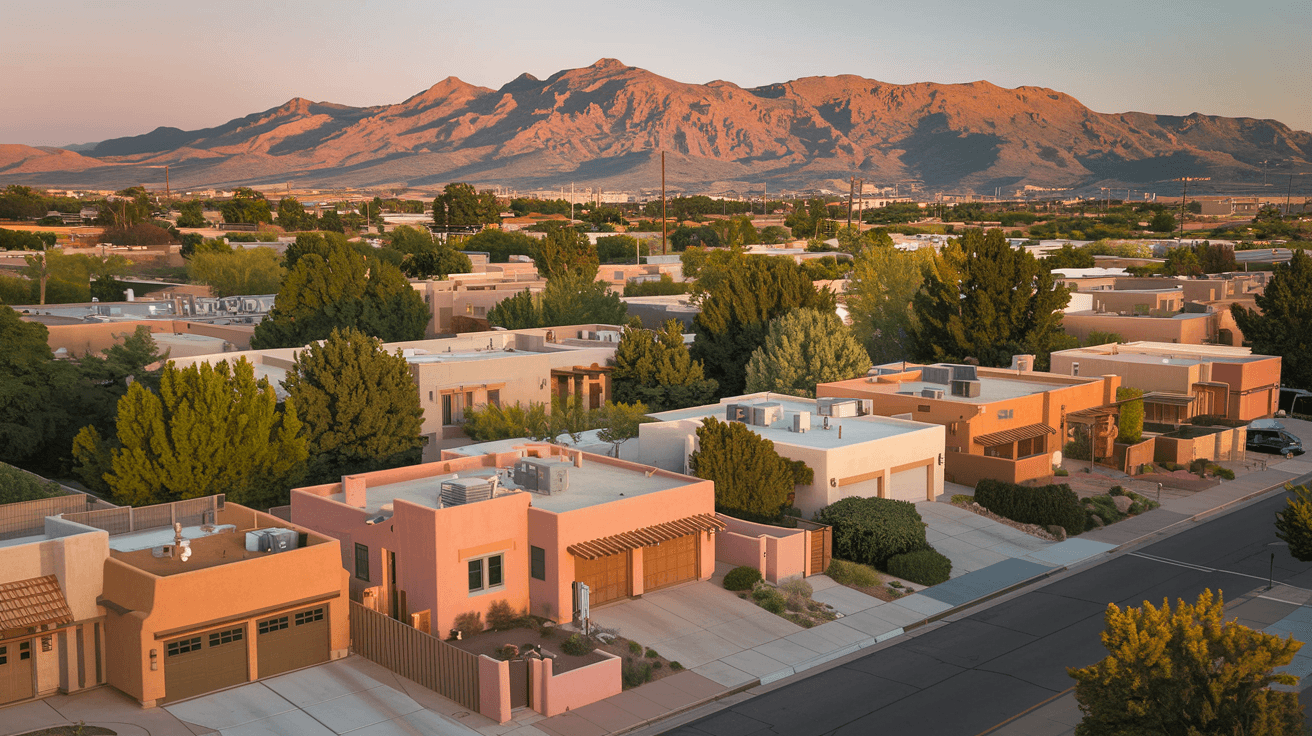
In the North Valley, you are looking at older adobe homes on larger lots, often with acequia access and mature cottonwood trees that turn gold every October along the Rio Grande bosque. These properties carry character that newer construction simply cannot replicate.
In Nob Hill and the University area, walkability is real. You can grab breakfast at Flying Star on Central, walk to Nob Hill Bar and Grill for dinner, and never start your car. Homes here are smaller but the lifestyle return is significant.
Rio Rancho and the West Side offer newer construction, larger floor plans, and prices that can still dip below $350,000 for a well-maintained three-bedroom. Families relocating from suburban Denver will recognize the feel immediately.
The Northeast Heights gives you proximity to Sandia Mountain trails, strong school options, and established neighborhoods where a $400,000 budget still gets you four bedrooms and a yard large enough to matter.
If you want to talk through which neighborhood actually fits your lifestyle and budget, the Taylor Team works these streets every day and can walk you through what is realistically available right now.
Everyday Cost of Living in Albuquerque: Groceries, Utilities, and Transportation
Housing is the headline, but the supporting cast matters too.
Groceries in Albuquerque run slightly below the national average. You have access to a full range of options: Sprouts and Whole Foods for the health-conscious, Smith's and Walmart Neighborhood Market for everyday staples, and the Downtown Growers Market on Saturday mornings on Robinson Park if you want the freshest green chile and produce in the city. Speaking of green chile, buying a sack of fresh Hatch chiles in late August and getting them roasted at a local stand on Isleta or near Lowe's on Coors will cost you maybe $25 to $30 for enough to last through winter. That is not a line item in a Denver budget.
Utilities deserve a real conversation. Albuquerque sits at 5,300 feet elevation in a high desert climate. Summers get hot, easily 95 to 100 degrees through July and August, and winters can bring genuine cold, though rarely the sustained deep freezes of Denver. PNM handles electricity, and summer cooling bills can run $150 to $200 for an average home during peak months. The shoulder seasons, spring and fall, are extraordinarily mild and your utility bills reflect that. Annual average utility costs tend to run lower than Denver and significantly lower than Austin, where summer electricity bills can become genuinely alarming.
Transportation costs favor Albuquerque in a specific way: gas prices here typically run below the national average, and the city is designed around the car in a way that keeps commutes manageable outside of the I-25 and I-40 interchange during rush hour. If you are coming from Austin's MoPac corridor or Denver's I-70 backup, the word "traffic" means something different here. It is not nonexistent, but a 25-minute commute from the Heights to Downtown is a realistic daily experience, not an optimistic fantasy.
Cost of Living ABQ vs Denver: The Specific Numbers That Matter
For the Denver transplant specifically, a few comparisons worth putting side by side:
- •Median home price: Denver roughly $560,000 vs Albuquerque $445,000
- •Average property tax on a $450K home: Denver area $3,500 to $5,000 vs Albuquerque $2,500 to $3,500
- •Average 1-bedroom apartment rent: Denver $1,700 to $2,100 vs Albuquerque $1,100 to $1,400
- •Average gas price: Denver typically $0.20 to $0.40 higher per gallon
- •Ski access: Both cities have it. Albuquerque has Sandia Peak, and Taos Ski Valley is about 2.5 hours north, Santa Fe Ski Basin is 65 miles up I-25. Not Breckenridge, but not nothing either.
The lifestyle trade you make coming from Denver is primarily about scale. Denver has a larger downtown, more professional sports, more concert venues. What you gain in Albuquerque is financial margin, and for a lot of people right now, that margin is what allows them to actually enjoy their lives instead of just funding their zip code.
Moving to Albuquerque from Austin: What the Numbers Look Like
The moving to Albuquerque from Austin conversation has a specific texture to it because Austin transplants are often dealing with a different kind of sticker shock. Many people bought in Austin five or six years ago and watched their equity explode, which means they are arriving in Albuquerque with real purchasing power.
If you are selling a home in Austin's Bouldin Creek or South Congress corridor, you may be sitting on $200,000 to $400,000 in equity. Bringing that to the Albuquerque market, where the median is $445,000 and the inventory is lean but not insane, puts you in a genuinely strong position. You could potentially arrive here with little to no mortgage, or a very manageable one, and redirect that monthly payment differential into savings, retirement, or just the experience of living without financial anxiety.
The property tax relief is the number Austin folks react to most viscerally. Travis County property taxes are brutal. Homeowners in central Austin neighborhoods routinely pay $10,000 to $18,000 per year in property taxes on homes that have appreciated far beyond their original purchase price. Moving to New Mexico and paying $3,000 on a comparable or larger home feels, in the words of more than one client, "almost illegal."
“"The property tax difference alone between Austin and Albuquerque can free up $700 to $1,000 a month. That is a car payment, a vacation, or just peace of mind."
What Austin people sometimes need to recalibrate: dining and nightlife in Albuquerque is genuinely good but operates on a different scale. The food scene along Central Avenue, in Nob Hill, and in Old Town is excellent. Sadie's on 4th Street has been making the best New Mexican food in the city for decades. Sawmill Market off Old Town is a local food hall that surprises most newcomers. But if you are used to Austin's Rainey Street scene every weekend, the adjustment is real. The tradeoff is that you can afford to own a home here, and that changes the entire texture of your daily life.
The Insider Detail Most Relocation Guides Skip
Here is the thing almost no relocation guide tells you about Albuquerque's cost of living: the "December to February" window in the real estate market. Most buyers from out of state arrive in spring or summer, when competition peaks and inventory is at its tightest. Local buyers who know the market understand that winter listings in Albuquerque are often priced more favorably, sellers are more motivated, and you face less competition. The city does not slow down the way northern markets do in winter, because the weather is genuinely mild most of the time. A savvy buyer relocating from Denver or Austin who can be flexible on timing and gets here in January with pre-approval in hand will almost always do better than the same buyer arriving in April.
What the Albuquerque Real Estate Market Means for Your Relocation Timeline
With only about 2.7 months of inventory and homes averaging 22 days on market before going under contract, the Albuquerque market rewards preparation. This is not a city where you can arrive for a weekend, fall in love with a house on Saturday, and expect to think about it for two weeks. At a 98.5 percent list-to-sale ratio, the market is telling you clearly that sellers have leverage and buyers who hesitate lose.
That does not mean you rush into something wrong. It means you do your homework before you arrive. Know your neighborhoods. Know your commute. Know your school priorities. Get pre-approved before you land at Sunport. Have a clear sense of whether you want the character of the North Valley, the convenience of the Heights, or the value of the West Side.
The Taylor Team works specifically with buyers relocating from out of state and understands that the process looks different when you are making decisions from 800 miles away. Virtual tours, neighborhood video walkthroughs, and honest conversations about what each area actually feels like day to day are part of how that process works.
Albuquerque's cost of living advantage is real, and for buyers coming from Denver or Austin, the financial reset can be genuinely life-changing. The key is arriving with the right information, the right expectations, and someone in your corner who knows the difference between a good deal on Tramway and an overpriced listing on Montgomery. That is exactly the kind of conversation worth having before you pack the first box.
Want more insider intel?
Subscribe to get market updates and new articles delivered to your inbox.